A1
Grammar
Simple Present Tense
How to form the simple present tense
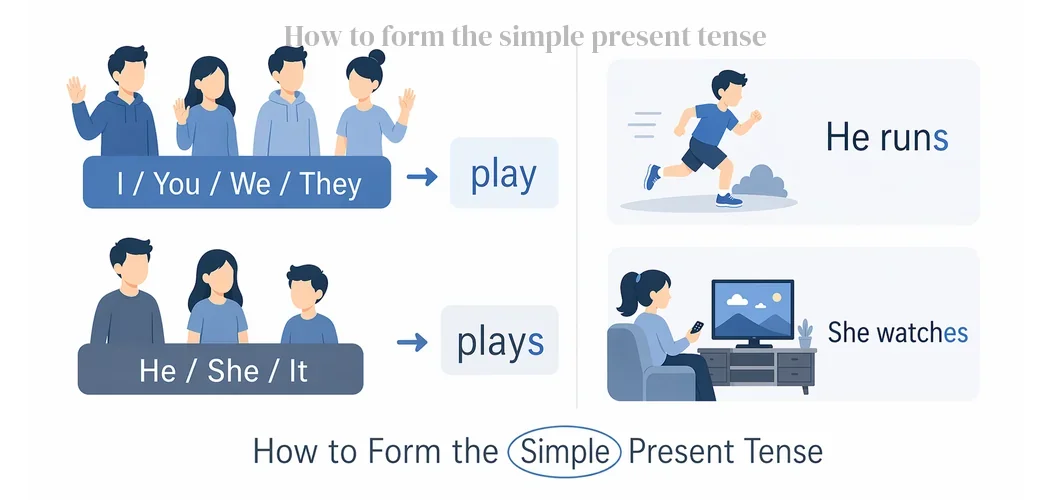
Introduction to Simple Present Formation
The simple present tense is one of the most important tenses in English. We use it to talk about habits, routines, facts, and general truths. Forming the simple present is easy! For most subjects, you use the base form of the verb. For third person singular (he, she, it), you usually add -s or -es to the verb. Let's learn the rules step by step.

Where the Simple Present Tense sits on the English tense timeline
Formula
✔ Positive
Subject
+
base verb (or base verb + -s/-es)
I play football every day.
✖ Negative
Subject
+
do/does not
+
base verb
I do not play football.
? Question
Do
+
Subject
+
base verb
Do you play football?
Examples
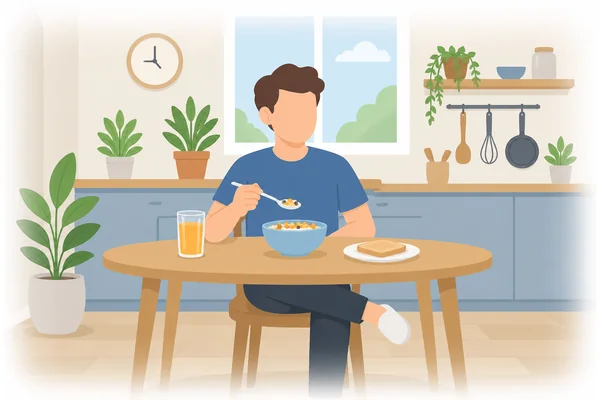
Example 1
I eat breakfast every morning.
Positive · First person · Routine

Example 2
He works in an office.
Positive · Third person singular · Habit
Example 3
She does not enjoy watching horror movies.
Negative · Plural · Preference

Example 4
Does your teacher speak English?
Question · Third person singular · Ability

Example 5
We go to school on weekdays.
Positive · Plural · Routine
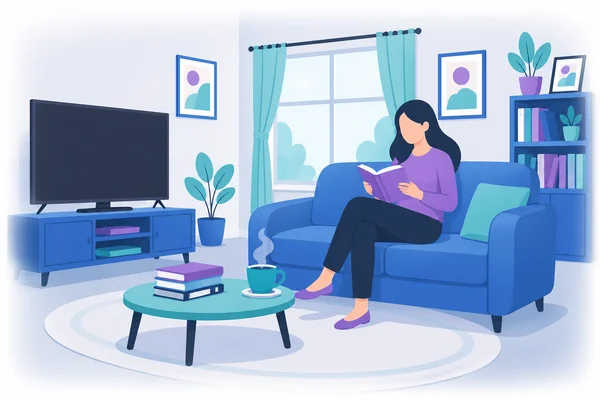
Example 6
She does not watch television.
Negative · Third person singular · Habit
When to use it
Daily routines
Talk about activities you do every day or regularly. This is the most common use of simple present.
"I wake up at 7 o'clock and drink coffee."
Facts and truth
State general facts about the world that don't change.
"The sun rises in the east."
Likes and dislikes
Express your preferences and feelings.
"I love chocolate, but she doesn't like it."
Habits and hobbies
Describe what you do regularly for fun or as a habit.
"He plays guitar three times a week."
Signal words
every day
every week
always
usually
sometimes
never
often
on Monday/Tuesday...
in the morning
at night
normally
seldom
Common mistakes
Wrong
He go to school.
Correct
He goes to school.
Third person singular needs -es. 'Go' becomes 'goes'.
Wrong
Do she like apples?
Correct
Does she like apples?
Third person singular uses 'does', not 'do'.
Wrong
I doesn't eat meat.
Correct
I don't eat meat.
First person uses 'don't', not 'doesn't'. Only 'does' for he/she/it.