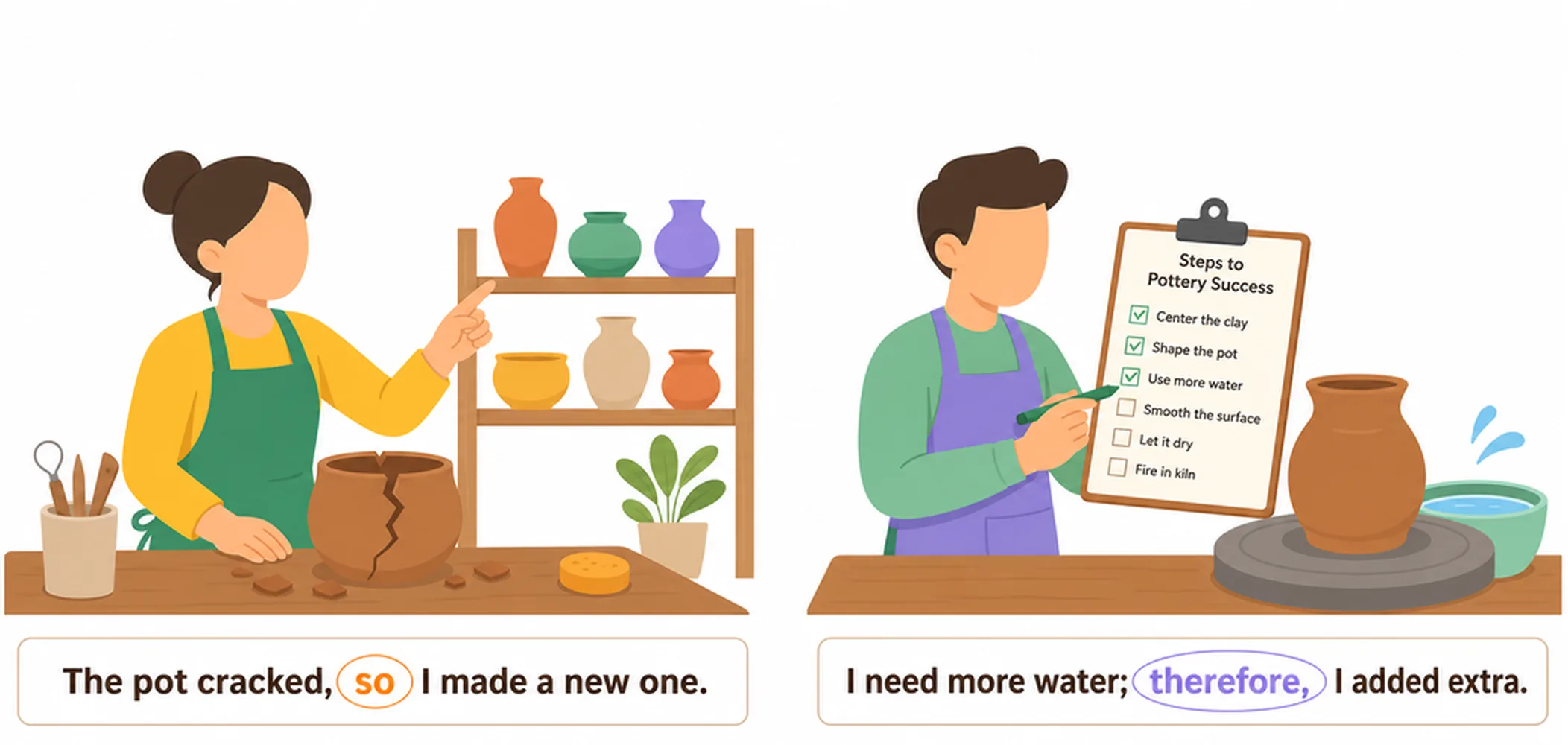
So vs Therefore: Key Difference
Both 'so' and 'therefore' show cause and effect — they connect an action or situation to its result. However, they differ in formality and how you use them in sentences. 'So' is a coordinating conjunction used in everyday speech and informal writing. 'Therefore' is a formal connector, often found in academic writing, reports, and professional communication. Understanding when to use each will help you write and speak more naturally at different levels.
So vs Therefore: Side-by-Side Comparison
| Dimension | So | Therefore |
|---|---|---|
| Form | Coordinating conjunction | Conjunctive adverb (transitional adverb) |
| When to use | Use to connect two independent clauses informally, showing that the second clause is a result or consequence of the first. Best suited for everyday speech and casual writing. | Use to introduce a logical conclusion or consequence in formal, academic, or professional writing. Signals a reasoned deduction from the information already given. |
| Positive example | It was raining, so we stayed indoors. | The experiment yielded inconsistent results; therefore, further testing is required. |
| Negative example | She did not study, so she did not pass the exam. | The data was insufficient; therefore, no valid conclusion could be drawn. |
| Question example | You missed the meeting, so what did you decide to do? | The policy has changed; what, therefore, should the committee recommend? |
| Formality level | Informal to neutral — common in conversation, casual emails, fiction, and everyday writing | Formal to neutral — common in academic papers, legal documents, business reports, and technical writing |
| Punctuation usage | Preceded by a comma when joining two independent clauses: She was tired, so she left early. No semicolon needed. | Typically preceded by a semicolon (or starts a new sentence) and followed by a comma: She was tired; therefore, she left early. |
| Sentence position | Always appears between the two clauses it connects; cannot be moved to the middle or end of the second clause. | Flexible — can appear at the beginning, in the middle, or at the end of the second clause: He was, therefore, dismissed. |
| Key signal words | As a result, and so, that's why, which is why | Thus, hence, consequently, as a result, for this reason, accordingly |
| Key Difference: Both so and therefore express a result or logical consequence, but they differ in grammar and register. So is a coordinating conjunction used in informal contexts; it joins clauses directly with only a comma. Therefore is a conjunctive adverb used in formal contexts; it requires a semicolon before it (or a new sentence) and a comma after it, and it can be repositioned within the clause for emphasis. When in doubt, use so in everyday communication and therefore when precision and formality are required. | ||
Formula
✔ Positive
Independent clause 1
+
,
+
so
+
independent clause 2
I didn't have money, so I couldn't buy the ticket.
Examples

I was tired, so I went to bed early.
Informal · Everyday conversation

The weather was bad, so we decided to stay home.
Informal · Casual speech

She studied hard, so she passed the exam.
Informal · General usage

The data shows an increase in sales; therefore, the strategy was successful.
Formal · Academic writing

The company faced financial difficulties. Therefore, they reduced their workforce.
Formal · Business report

All mammals are warm-blooded; therefore, humans need to regulate body temperature.
Formal · Scientific writing
When to use it
Informal Conversation
Use 'so' when speaking casually with friends, family, or in everyday situations. It sounds natural and conversational.
"I was hungry, so I made a sandwich."
Academic Writing
Use 'therefore' in essays, research papers, and formal reports to show logical connections and sound more professional.
"The evidence supports the hypothesis; therefore, the conclusion is valid."
Professional Communication
Use 'therefore' in emails, business proposals, and formal presentations to maintain a professional tone.
"Sales increased by 20%; therefore, we will expand to new markets."
Signal words
as a result
for this reason
consequently
thus
that's why
because of this
Common Mistakes
✕
Wrong
The store was closed therefore we couldn't buy anything.
✓
Correct
The store was closed, so we couldn't buy anything. / The store was closed; therefore, we couldn't buy anything.
'Therefore' needs a semicolon or period before it, not a comma alone. 'So' works better with a comma.
✕
Wrong
I was sick. So I didn't go to work.
✓
Correct
I was sick, so I didn't go to work.
'So' as a coordinating conjunction connects two independent clauses and needs a comma, not a period.
✕
Wrong
She wanted a promotion so she was promoted.
✓
Correct
She wanted a promotion, so she worked harder.
'So' shows cause and effect. The second clause should show the result, not something unrelated to the reason.
KEY TAKEAWAYS
What to Remember
- Both 'so' and 'therefore' show cause and effect relationships between ideas or actions.
- 'So' is a coordinating conjunction used in casual conversation and informal writing.
- 'Therefore' is a formal connector typically found in academic, professional, and formal written contexts.
- Use 'so' to connect two independent clauses with a comma in informal speech.
- Use 'therefore' with a semicolon or as a transitional phrase in formal writing.